Published on 3 March 2025 · Updated on 9 July 2026 · by Ismail Nasry
In brief: 30 years of video games, from Doom to The Last of Us: a personal take on digital violence, moral panic, censorship, and why the problem isn't pixels but who plays without context.
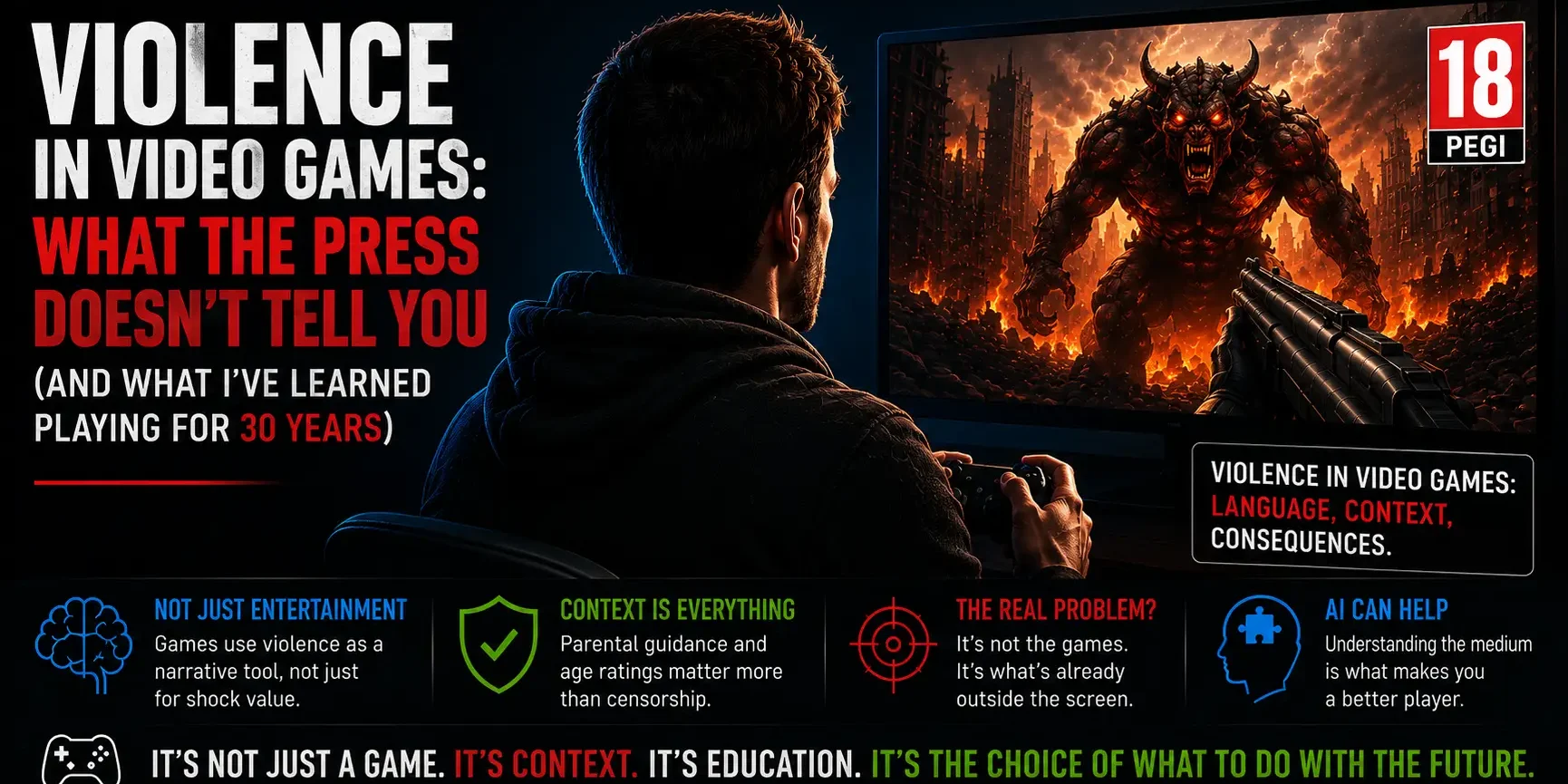
Violence in Video Games: What the Press Doesn’t Tell You (and What I’ve Learned Playing for 30 Years)
I started playing video games at 6 on a Commodore 64. By 10, I was playing Doom — demons, shotguns, pixelated blood. My mom would walk into the room, see screens of digital carnage, and sigh. She never confiscated the console, but I remember her worry clearly. Today, at almost 40, I’ve never stabbed anyone, never shot anyone, and the only time I’ve raised my voice was over a faulty NVIDIA driver.
This article isn’t an academic essay. It’s the perspective of someone who has lived video games firsthand — as a player, as a developer, and as someone who has watched moral panic cycles repeat identically for three decades.
The Infinite Cycle of Moral Panic
Every time a new medium becomes popular, the reaction is always the same:
- 1950s: comic books cause juvenile delinquency (Dr. Wertham’s study, later debunked)
- 1980s: heavy metal leads to satanism
- 1990s: rap and violent video games corrupt the youth
- 2020s: social media and AI destroy attention spans
Violence in video games is just the latest (or perhaps the longest-lived) iteration of this pattern. The problem was never the medium — it’s the fear of the new, amplified by a press that knows “violent video game” sells more copies than “longitudinal study on youth aggression.”
I remember the Rule of Rose case (2006). Italian newspaper headlines: “Video Game Where You Bury a Child Alive.” The reality? A non-interactive dream sequence of a few seconds, part of a narrative nightmare. No one contextualized it, no one explained it was a cinematic segment in a game about bullying and abandonment. Half an hour of gameplay was enough to understand it, but half an hour doesn’t make news.
The Research Says What No One Wants to Hear
I’ve spent years reading studies on this topic out of personal curiosity. The conclusion the scientific community reaches (when not funded by interested parties) is boring, and precisely for that reason it doesn’t make headlines: there is no causal correlation between violent video games and real-world violent behavior.
Studies by Christopher Ferguson or the meta-analyses by Andrew Przybylski show that:
- The correlation between violent games and aggression is minimal (smaller effect than secondhand smoke on health, for context)
- The real factors in youth aggression are entirely different: family environment, school bullying, socioeconomic issues
- Violent games can even have positive effects: problem-solving, emotional regulation, controlled frustration release
But saying this publicly doesn’t benefit anyone. Not politicians (who want to appear “concerned about the youth”), not newspapers (who want easy clicks), not pressure groups (who live on fear-based donations).
From Player to Developer: Violence as a Narrative Tool
When I started developing games, I understood something I sensed as a player but couldn’t articulate: violence in video games is almost always a language, not an end goal.
Take The Last of Us. The violence there is ugly, dirty, uncomfortable. Every kill weighs on you. The game forces you to do horrible things to survive and then shows you the consequences. It’s not a power fantasy — it’s an ethical nightmare. If a teenager plays The Last of Us and gets the message, they’ve received a more powerful lesson in empathy than any civics textbook could provide.
Take Spec Ops: The Line. It uses violence to make you feel guilty. It manipulates you, makes you commit an act of war with white phosphorus on civilians, and then asks: “Was it worth it?” It’s one of the most anti-war games ever made, and it works because it puts you in the shoes of the one committing violence, not the one suffering it.
Then there are games where violence is purely a gameplay tool — like Doom or Serious Sam. There it’s pure catharsis, digital choreography. It says nothing except “you’re powerful, have fun.” And that’s okay. Action cinema is the same: no one asks John Wick to have a social message.
The Problem Isn’t Violence in Games. It’s Who Plays Without Context.
The real question no one asks is: who’s playing? A 12-year-old with Grand Theft Auto V is not the same as a 25-year-old playing it. The problem isn’t the game — it’s the absence of parental mediation. PEGI exists precisely for this. The problem is that many parents don’t know what PEGI is, or they ignore it because “they’re just games.”
I made the opposite mistake myself: as a kid I played Carmageddon (one of the most censored games in Europe) because I found it fun. It didn’t turn me into a road terrorist. It taught me that virtual destruction is a sandbox, not a behavior guide.
What’s needed isn’t more censorship. It’s education about the medium — for parents, teachers, journalists. Knowing how to distinguish between a game that uses gratuitous violence and one that uses it to ask a question. Knowing that at age 8 it’s probably better to avoid certain titles, but at 16 it’s not. Knowing that banning everything has never worked — it only made forbidden games more desirable.
Censorship: The Cure Worse Than the Disease
The case of Grand Theft Auto: San Andreas and the infamous “Hot Coffee” mod is emblematic. Once a hidden sexual scene (inaccessible without a mod) was discovered, Rockstar was forced to recall millions of copies. Result? The game sold even more, the mod became legendary, and the only thing the public remembers is “GTA San Andreas? That scandalous game.” No one remembers it was a masterpiece of writing and open-world design.
Censorship has never protected anyone. It only fueled the appeal of the forbidden and gave free publicity to developers. The only real effect was limiting artistic freedom and making it harder for adults to enjoy works made for them.
FAQ
Do violent video games really cause aggressive behavior?
No. The most solid research shows no causality. The real factors in youth aggression are family environment, bullying, socioeconomic issues. Video games are a convenient scapegoat.
Why does the press keep claiming the opposite?
Because “study shows violent video games…” sells more copies than “study shows no correlation.” Sensationalism pays, boring science doesn’t.
Do rating systems like PEGI actually help?
Yes, if used properly. PEGI provides clear guidance for parents. The problem is that many parents don’t know it exists or ignore it.
What’s the difference between gratuitous violence and narrative violence?
Narrative violence has a purpose: to tell something, provoke a reaction, develop a character. Gratuitous violence is there purely for entertainment. Both have a right to exist — but it’s important to know the difference.
Should a parent worry if their child plays violent games?
Rather than worrying, they should play with them. Understand what they’re playing, why they like it, what it’s about. Parental mediation is far more effective than prohibition.
Are there video games that use violence constructively?
Several. The Last of Us, Spec Ops: The Line, This War of Mine, Papers, Please — all use violence or tension to tell something profound. They’re examples of how the medium can be mature and reflective.
Conclusion
Violence in video games isn’t the problem. It never was. The problem is a society that looks for easy scapegoats instead of addressing the real causes of youth distress. The problem is a press that prefers scandal over depth. The problem is a political class that legislates for likes, not for competence.
I’ll keep playing, developing, and defending the medium. I’m almost 40, I have a family, a job, and I still play Doom when I want to switch my brain off. If violence in video games could really “corrupt” someone, I think after 30 years I’d have shown signs of it by now.
But maybe the real problem is another: it’s not that video games make us violent. It’s that we don’t want to admit that violence already exists — outside the screen — and that blaming pixels is easier than doing something useful.
Work with me
Need help with this topic? I develop custom solutions tailored to your needs.