
Published on 8 March 2025 · Updated on 9 July 2026 · by Ismail Nasry
In brief: The impact of AI on new programmers: personal experiences with PromptMaster Pro, dependency risks, and how to use AI to truly learn without losing problem-solving skills.
The Impact of AI on New Programmers: What No Virtual Tutor Tells You
I started programming with an English manual I half-understood, and a compiler that spat out cryptic errors in a language that wasn’t mine. Every error was a puzzle solved with hours of trial, pages of documentation, and forums. It was slow, frustrating, but it taught something that no AI assistant teaches: resilience.
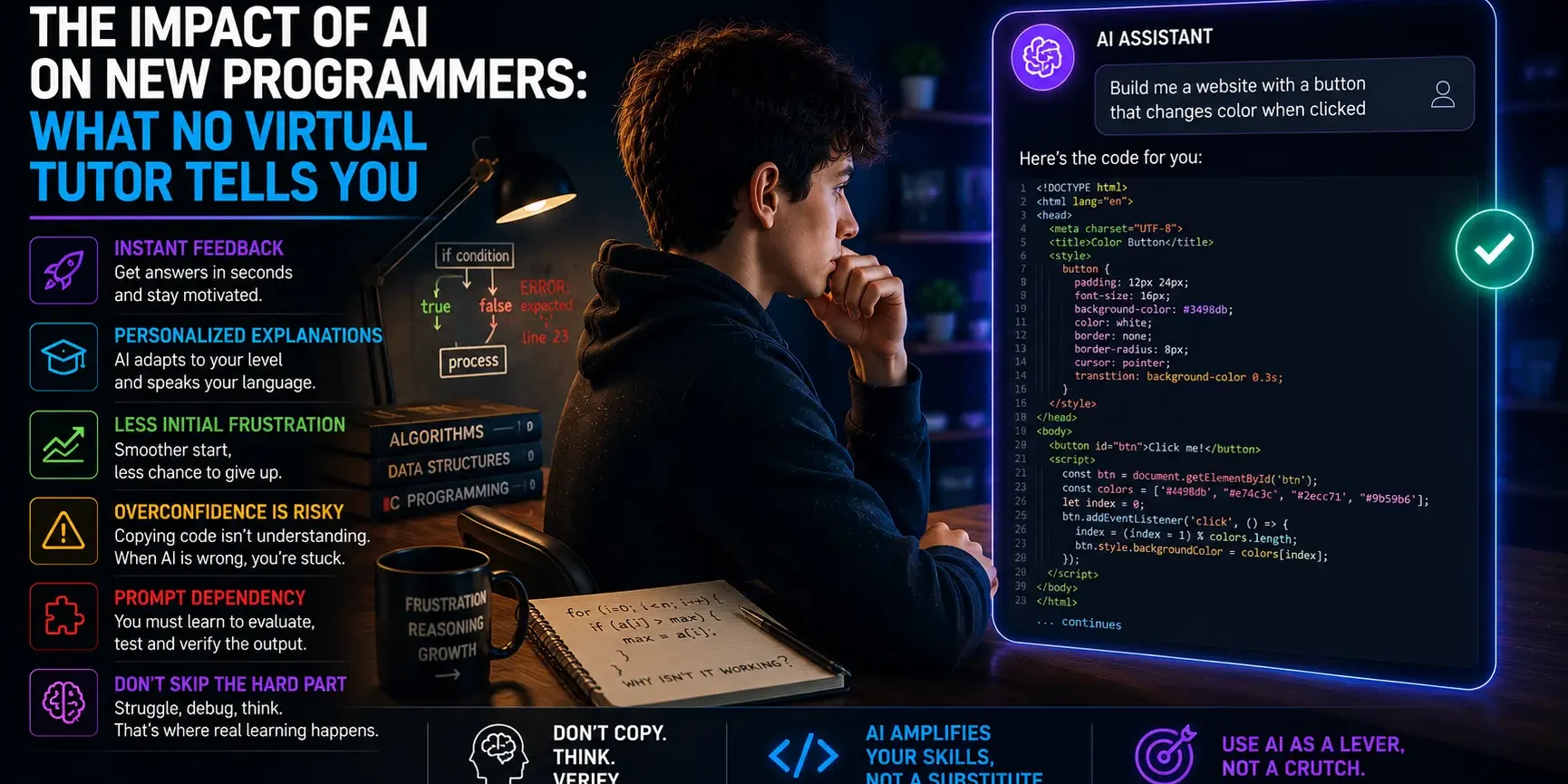
Today, a 16-year-old can open ChatGPT and say: “make me a website with a button that changes color when clicked.” In 30 seconds, they have working code. The question is: what do they actually learn in those 30 seconds?
This isn’t a critique of AI — I use it daily with PromptMaster Pro and couldn’t do what I do without it. But it’s a reflection on what it means to learn programming in an era where the answer is always one prompt away.
The Real Benefits of AI as a Tutor
I’d be a hypocrite not to acknowledge the benefits. AI has democratized access to programming in ways I could only dream of:
- Instant feedback: a beginner doesn’t have to wait hours on a forum to understand why their code doesn’t work. AI responds immediately, and that keeps motivation high.
- Personalized explanations: “explain recursive functions like I’m 10” actually works. AI adapts its language to the student’s level.
- Reduced initial frustration: programming’s learning curve is steep. AI smooths out the first obstacles, preventing many from giving up before they even start.
With PromptMaster Pro, I see daily how much AI can accelerate learning. My AI agents explain complex concepts, generate examples, suggest optimizations. But there’s a fundamental difference between using AI to understand and using it to delegate.
The Dark Side: What You Lose by Delegating Understanding
The risks I see in new programmers who rely too heavily on AI are three:
- Illusion of competence: copying working AI code feels like knowing how to program, but it doesn’t teach you to think like a programmer. When AI gets it wrong — and it will — those who don’t understand can’t even diagnose the error.
- Prompt dependency: a developer who can’t write code without AI is a developer who can’t evaluate AI output. The perfect prompt doesn’t exist — what exists is the ability to verify what AI produces.
- Missing fundamental problem-solving: the frustration of not being able to fix a bug isn’t a flaw in the learning process — it’s a feature. That frustration teaches you to break down problems, reason by hypothesis, and search systematically.
I know developers who use AI as a crutch and can’t write a single function without autocomplete. And developers who use it as a lever — they design the architecture, AI writes the boilerplate. The difference is the same as always: understanding what you’re doing.
My Advice for Beginners Today
If you’re learning to program and have access to AI, here’s how to use it without losing the value of learning:
- Try it yourself first: before asking AI, try to solve the problem with your own knowledge. Even if you fail, the attempt builds mental connections that copy-paste doesn’t create.
- Ask for explanations, not code: instead of “write me a function that does X,” ask “how do you design a function that does X? What are the logical steps?”
- Analyze AI output: when AI gives you code, read it line by line. Modify it. Break it. Then fix it. That’s where real learning happens.
- Alternate AI and hand-written code: one project out of three, do it completely without AI. This keeps your fundamental skills sharp.
The AI Paradox in Education
AI is a wonderful tool for those who already know how to program. For beginners, it’s a double-edged sword. It lowers the entry barrier and makes programming more accessible, but risks creating a generation of developers who can get results without understanding how they work.
The solution isn’t banning AI for beginners — that would be like banning calculators in math. The solution is teaching them to use it consciously, as a learning tool and not a shortcut to skip learning.
As I always say: AI is an amplifier. It amplifies the skills of those with solid foundations, but it also amplifies the ignorance of those without. The problem isn’t AI. It’s what we choose to do with the shortcut.
Work with me
Need help with this topic? I develop custom solutions tailored to your needs.


