
Published on 25 April 2025 · Updated on 8 July 2026 · by Ismail Nasry
In brief: Trust, quality, and transparency beat price: why serving clients with ethics and professionalism is the only real competitive advantage.
Serving Clients with Ethics and Professionalism: Beyond Price
A few years ago, a potential client called me for a quote. He wanted a website. I sent a detailed proposal: analysis, design, development, testing, documentation. He went with another developer who charged half the price. Six months later, he was back asking me to rebuild everything from scratch – the “cheap” site was slow, failed accessibility checks, and the code was a mess.
In the end, he paid twice what he would have paid initially. And I lost time rebuilding on someone else’s rubble. That experience taught me a lesson I still carry: price is not value. Trust is. And trust is built with quality, transparency, and – sometimes – the courage to say no.
Why Trust Beats Price (Always)
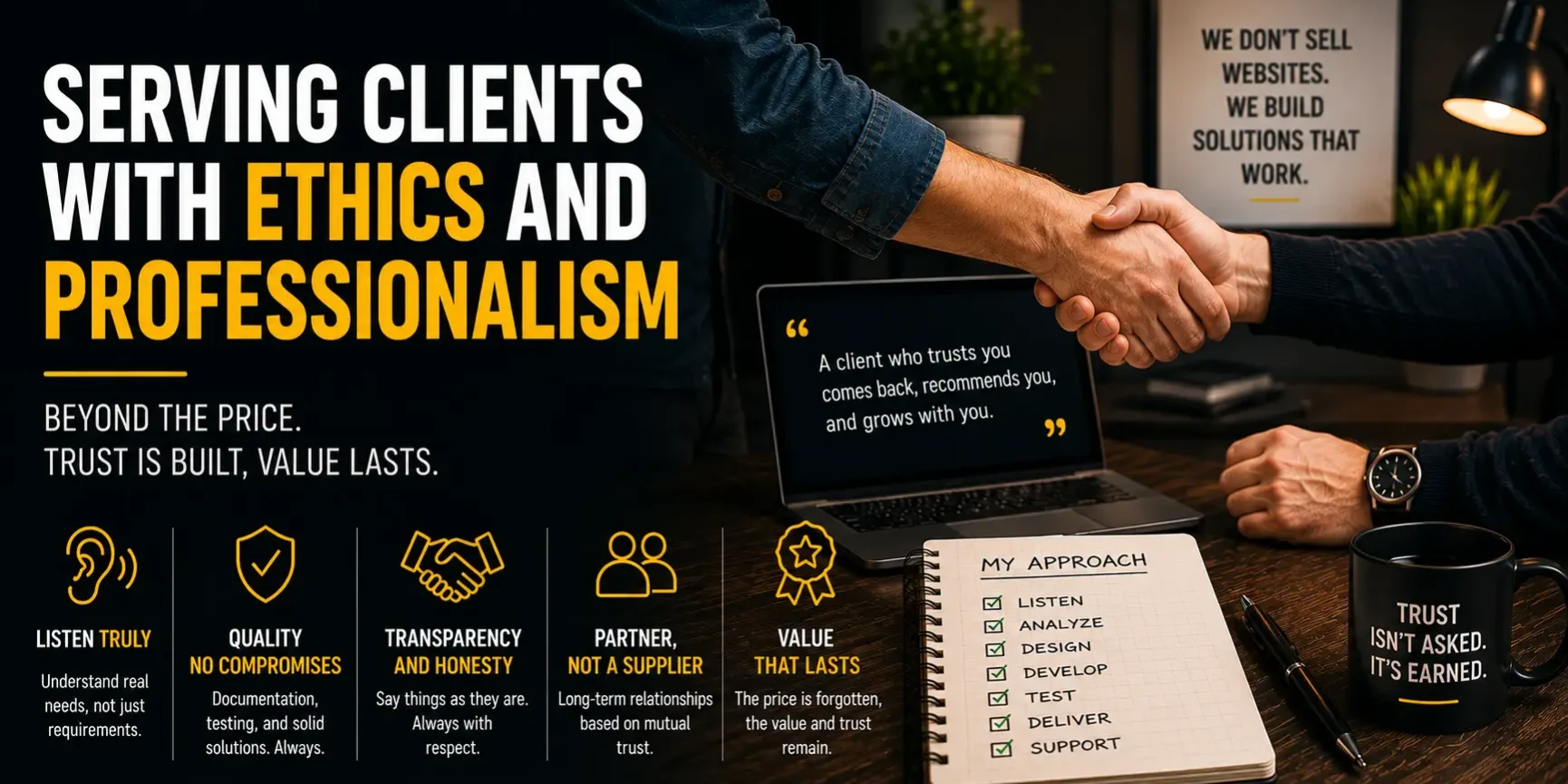
In the world of professional services, trust is the only real competitive advantage. Not speed, not price, not the most impressive portfolio. Trust. Because a client who trusts you comes back. A client who trusts you recommends you. And a client who trusts you doesn’t treat you like a vendor – they treat you like a partner.
With PromptMaster Pro, I applied the same logic: instead of shipping a minimum viable product and fixing it later (as many AI tools do), I invested time in testing, real feedback from beta testers, and clear documentation. The result? The first users didn’t just stay – they brought others. Because they trusted.
Really Listening to the Client
The listening phase is where most projects succeed or fail. Not listening to respond, but listening to understand. When a client says “I want a beautiful website,” they often mean “I want a site that brings me clients, is easy to update, and loads fast on mobile.” My job is to translate their desire into technical requirements.
Questions I always ask:
- “What problem are you trying to solve?” – not “what feature do you want?” but “what keeps you up at night?”
- “Who are your clients?” – not “how many visitors?” but “what are they looking for when they land on your site?”
- “What happened with your previous site?” – if there was a failure, I want to understand why, so I don’t repeat it
One client told me “I want a site like my competitor’s.” After two questions, I discovered their real need was an automated booking system, not a specific design. I saved them thousands of euros and months of wrong work.
The Dangers of Competing on Price Alone
Competing on price is a race to the bottom that nobody wins. The client gets less value, the professional works at a loss, and market quality collapses. I’ve seen colleagues burn out in a few years because they accepted underpaid projects and couldn’t deliver on their promises.
I have a rule: if a project doesn’t let me do good work, I turn it down. It sounds counter-intuitive, but the best projects came right after I said no to the wrong ones.
Where never to cut corners:
- Documentation: without it, the project becomes a mystery for anyone who touches it after me
- Testing: on PromptMaster Pro, every release goes through automated tests. A bug in production costs far more than a skipped test
- Scalability: a solution that works today but collapses tomorrow isn’t a solution at all
Transparency: Saying What the Client Needs to Hear
Being transparent also means saying uncomfortable things. “No, that technology isn’t right for you.” “No, that price is too low for what you’re asking.” “No, I can’t deliver in two weeks a project that needs six.”
A consultant who always says yes isn’t useful to anyone. Transparency is an act of respect toward the client. And every professional “no” is an investment in the long-term relationship.
Knowing When to Walk Away
Turning down a project isn’t easy, especially early on when every client matters. But I’ve learned that some requests simply aren’t worth accepting:
- Projects with vague briefs: if the client doesn’t know what they want, the project will turn into a quagmire of endless revisions
- Unrealistic budgets: if the price is too low to do good work, it’s better to walk away
- Requests for unethical shortcuts: copying content, bypassing licenses, publishing undisclosed links – never
Every time I’ve said no to the wrong project, something better came along. That’s not philosophy – it’s experience.
Conclusion
Serving clients with ethics and professionalism means one thing: putting their real interest ahead of immediate gain. Price is what they pay. Value is what they receive. And trust is what remains when the project is done.
The client who came back after saving money on the first project? We’ve been working together for years now. He doesn’t ask for quotes anymore. He says: “you decide, I trust you.” That sentence is worth more than any contract.
Work with me
Need help with this topic? I develop custom solutions tailored to your needs.


