
Published on 6 June 2025 · Updated on 8 July 2026 · by Ismail Nasry
In brief: From expired plugins to disappearing video games: concrete risks of unrenewed licenses and how to manage them. Practical guide with real cases and solutions.
Expired Licenses: Risks, Opportunities, and Real Cases
A few years ago, a client called me in a panic: their site was down because a security plugin license had expired three months earlier. Nobody noticed. The plugin stopped receiving updates, a critical bug was exploited, and the server was compromised. Recovering the data cost more than triple the annual license renewal.
That’s the lesser-known side of expired licenses: not just creative reuse opportunities, but concrete risks for businesses, professionals, and users. In this article, I explore the other side of the coin — what happens when a license expires and nobody notices.
What Licenses Are and Why They Expire
A license is a legal agreement that lets you use something you don’t own — software, music tracks, patents, images. It defines how long, under what conditions, and with what limitations you can use it.
When it expires, rights revert to the owner or the work enters the public domain. The problem is that many licenses expire silently: the software still runs, the music still plays, the patent isn’t revoked. But legally, the use is no longer authorized.
Why Expired Licenses Are Ignored
Three main reasons:
- Unclear contract terms: many licenses are written in legal language few people read thoroughly
- No notification: unlike a Netflix subscription, most software licenses don’t send reminders
- False sense of functionality: if the program still launches, many assume everything is fine
As a professional working with dozens of tools and platforms daily, I’ve learned the hard way that ignoring an expiration always costs more than preventing it.
Real Cases I’ve Seen (and One That Struck Me)
Enterprise software and plugins: the client who lost their data
The story I opened with isn’t rare. WordPress plugins, antivirus licenses, expired SSL certificates: in my web development experience, most security incidents in small and medium business sites come from forgotten renewals, not sophisticated attacks.
I implemented a monitoring system for my clients precisely for this reason: automatic license expiration checks, monthly reports, alerts 30 days in advance. It’s a service few offer, but it makes the difference between a secure site and a disaster.
Alan Wake: when a video game disappears from stores
In 2017, Alan Wake was removed from Steam and Xbox Store because the rights to its licensed music tracks had expired. A critically acclaimed game — suddenly unavailable. It took an agreement between Remedy and Epic Games to bring it back years later.
This case is emblematic of a larger problem: the preservation of digital heritage. Films, music, video games that exist only as digital files and can disappear overnight due to licensing issues. It’s an ethical issue that touches our digital identity: what remains of us when the licenses expire?
Abandonware: the gray zone of digital preservation
Abandonware includes games and software still under copyright but no longer sold. Rights holders no longer distribute them, but fans continue to seek them out. Platforms like myabandonware.com keep them alive, but operate in a legally ambiguous context.
As a developer, I understand both positions: the need to preserve software history on one hand, and authors’ rights to control their work on the other. It’s a gray area that deserves a more serious debate than it’s currently getting.
Expired patents and market impact
After 20 years, a patent falls into the public domain. That’s how generic drugs are born (prices drop, accessibility rises) and how technologies like Wi-Fi became global standards. But for companies, patent expiration also means loss of exclusivity and sudden competition.
How I Manage Expired Licenses
After years of experience, I’ve developed a simple but effective system:
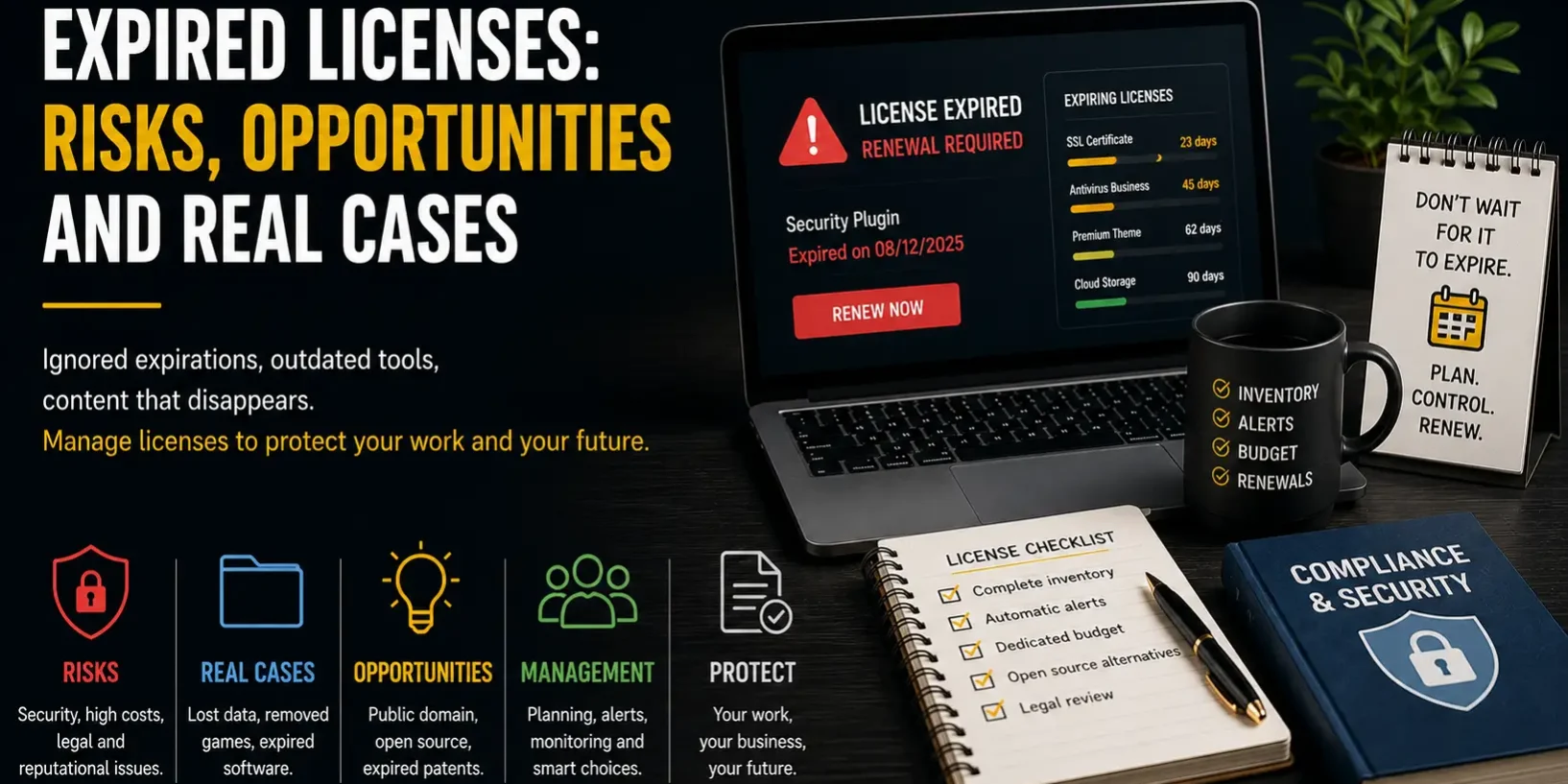
- Inventory: track every license, purchase date, expiration, and renewal. A spreadsheet is enough to start.
- Automatic alerts: set reminders 30-60-90 days before expiration. Most CRMs support this.
- Dedicated budget: renewals aren’t emergencies — they’re operating costs. Plan them as such.
- Open source alternatives: before buying an expensive license, ask yourself if an open source alternative does the same job. Often the answer is yes.
- Professional advice: for particularly complex licenses (patents, concessions, enterprise contracts), a specialized lawyer is an investment, not a cost.
In PromptMaster Pro, I integrated a license audit module precisely to help professionals track the tools they use. Because awareness starts with knowing what you have and when it expires.
Conclusion
Expired licenses aren’t just a legal or administrative problem. They reflect how we manage our digital and professional resources. Ignoring them is expensive, both economically and reputationally.
The aware professional doesn’t wait for expiration: they plan for it. And when possible, they choose tools that respect their freedom — open source, permissive licenses, sustainable models — because professional ethics starts with the choices we make every day about the tools we use.
Work with me
Need help with this topic? I develop custom solutions tailored to your needs.


