
Published on 27 March 2025 · Updated on 8 July 2026 · by Ismail Nasry
In brief: 3D configurators, virtual showrooms, and immersive training: the metaverse seen by someone who builds 3D Web experiences. Promises, real risks, and how to use immersive tech without losing yourself.
Metaverse: Promises, Risks, and What Nobody Tells You
A few years ago, I built a 3D Web configurator for a client: an interactive product model that visitors could rotate, zoom, and customize from their browser. When I finished it, I spent an hour just playing with it myself. It wasn’t a video game, it wasn’t the metaverse, but there was something magnetic about interacting with a 3D object without having the physical item in front of you.
The metaverse promises much more: persistent worlds, digital identities, virtual economies. But before getting swept up by the hype, it’s worth understanding what’s really there — and what risks few talk about.
What Actually Works in the Metaverse
From my work with 3D Web experiences (configurators, virtual showrooms, training environments), I’ve seen applications where immersive technology truly makes a difference:
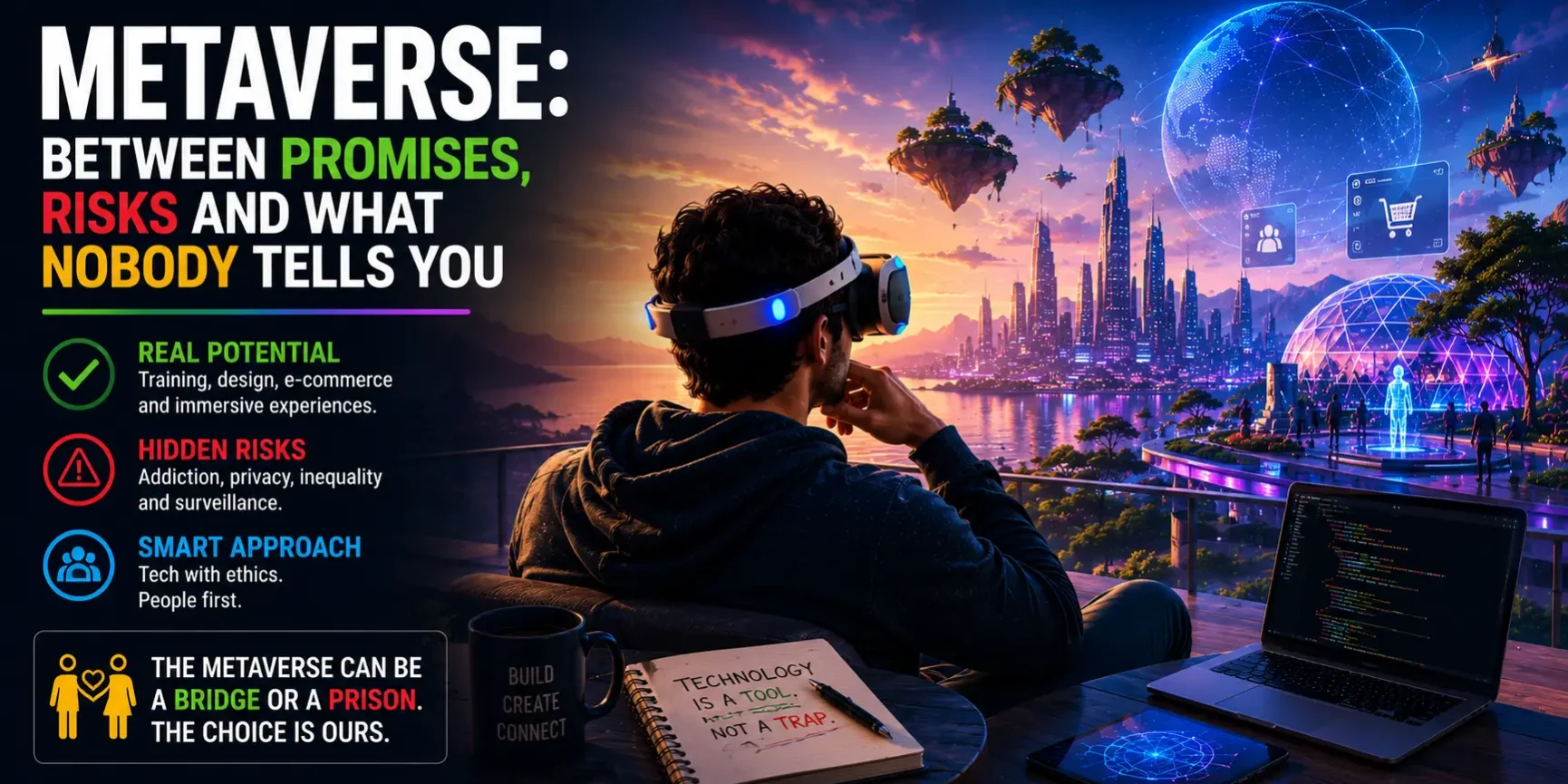
- Training and simulation: a 3D environment for training technicians on complex machinery reduces costs by 60% compared to physical training and eliminates risks entirely.
- Architecture and design: showing an interactive 3D building before it’s built is more effective than any rendering.
- Experiential e-commerce: a 3D configurator increases conversions by 40-80% compared to static images.
But the “general” metaverse — open worlds, cryptocurrencies, digital land — is a different story. The numbers speak clearly: most users abandon it after a few weeks. The technology is still immature, the devices are expensive, and the experience is often disappointing.
The Risks Nobody Wants to Address
As a developer working with immersive tech, I see three concrete risks that are often downplayed:
- Addiction and dissociation: a persistent virtual environment is designed to keep you inside. The engagement mechanics are similar to social networks but amplified by immersion. For young people, the line between real and virtual life can become dangerously thin.
- Privacy and surveillance: in the metaverse, your movements, facial expressions, and interactions are tracked in far more detail than on a website. Biometric data is the new gold, and companies know it.
- Digital inequality: the real metaverse requires expensive hardware (VR headsets, powerful PCs). It risks creating a gap between those who can afford it and those who cannot, widening existing inequalities.
My Approach: Ethical Immersive Technology
I believe in the potential of immersive technology. Every 3D configurator I build, every virtual training environment, confirms there’s a future in these tools. But I also believe the right way to develop them is with transparency and respect for the user.
I don’t build worlds designed to keep people inside. I build tools that help them do better what they already do — learn, choose, create. The metaverse shouldn’t be an escape from reality, but an extension of real possibilities.
For parents, the advice is simple: don’t demonize the metaverse, but don’t ignore it either. Inform yourselves, try it together with your kids, set limits, and keep talking. Technology isn’t the problem — unconscious use is.
The Bottom Line
The metaverse isn’t a passing fad, but it’s not the revolution many promise either. It’s an evolving technology with real potential and concrete risks. Like any powerful tool, what matters is how we use it.
For my part, I’ll keep building 3D experiences — configurators, training environments, virtual showrooms — but never losing sight of the line between useful and harmful. The metaverse can be a bridge or a prison. The difference is up to us.
Work with me
Need help with this topic? I develop custom solutions tailored to your needs.


