
Published on 22 May 2025 · Updated on 8 July 2026 · by Ismail Nasry
In brief: Lean teams and tight deadlines: how to avoid software release failure. Real mistakes, MVP strategies, internal demos, and honest stakeholder communication.
Avoiding Software Release Failures: Lean Teams and Tight Deadlines
Early in my career, I took on a project with a two-person team (including myself) and a three-week deadline for an application that needed at least six. The client knew it, but had promised the date to their investor. I worked nights and weekends, accumulated technical debt that took months to clean up, and delivered a barely functional product.
It wasn’t a success — it was a preventable incident. Since then, I’ve completely changed my approach to lean teams and tight deadlines. This article is what I wish I’d read before that project.
The Problem Isn’t the Small Team — It’s the Imbalance
Working with a lean team isn’t wrong. Small, focused teams often outperform large, scattered ones. The problem arises when resources are disproportionate to goals.
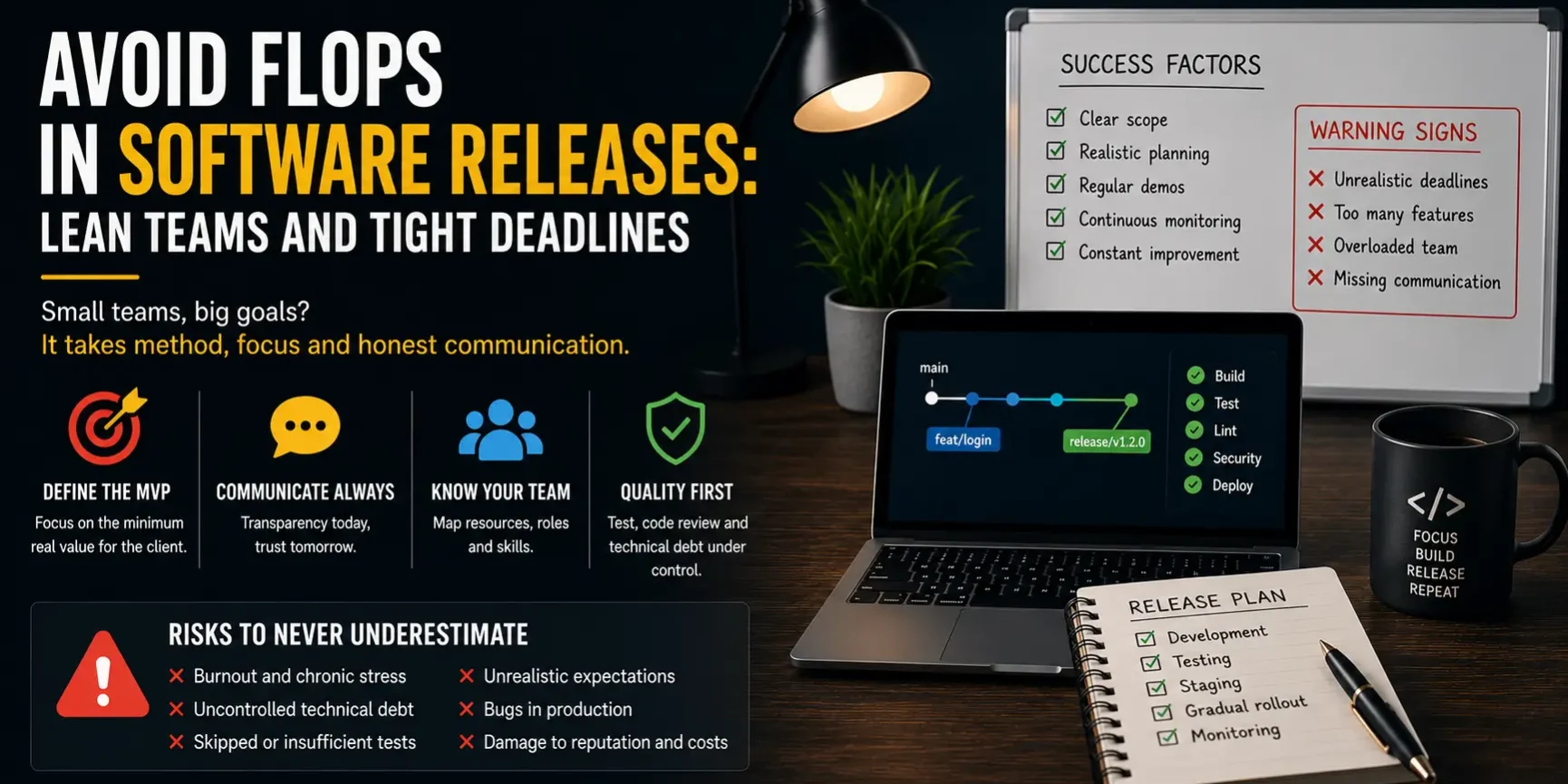
Signs I’ve learned to recognize:
- Silent burnout: when everyone works overtime without complaining, it’s already too late
- Never-repaid technical debt: every sprint adds debt, none gets repaid
- Normalized code smell: “we’ll fix it later” becomes the rule, not the exception
- Nobody has time to do their actual job: the person who should test is developing, the DevOps person is writing code
Duke Nukem Forever (14 years of development, understaffed team, inefficient management) is the extreme example of what happens when the imbalance is never corrected.
Tight Deadlines: I’ve Seen Them All Fail
In my experience, deadlines imposed from above without consulting the technical team are the leading cause of release failures. Two well-known examples:
- Apple Maps (2012): rushed to compete with Google Maps, full of errors and incomplete data. Tim Cook apologized publicly. Competitive pressure had won over technical common sense.
- Samsung Galaxy Note 7 (2016): in a hurry to beat competitors, batteries weren’t tested enough, devices caught fire. Global recall, billions in losses.
On a smaller scale, I’ve seen the same pattern in €5,000 projects: client imposes an unrealistic date, developer cuts testing, bugs emerge in production, relationship sours. The scale changes, the dynamics are identical.
How I Learned to Manage Lean Teams (Without Dying)
MVP Is Not an Excuse for Chaos
An MVP (Minimum Viable Product) doesn’t mean “do a bad job and hurry up.” It means: identify the smallest set of features that solves the client’s problem, and build it well. The rest comes later.
In my work, I define the MVP explicitly with the client: “this feature is included, this isn’t, this comes in the next version.” We sign off on the scope. Without that conversation, the client expects everything immediately, and the team kills themselves to deliver.
Internal Demos: My Lifesaver
Every Friday, I do an internal demo of what I developed that week. I don’t wait until the end of the project. This lets me:
- Catch problems before they become critical
- Verify the direction is right
- Show progress, even when the product isn’t finished
Clients appreciate the transparency. And I sleep better knowing there won’t be last-minute surprises.
Honest Communication with Stakeholders
The rule I live by: it’s better to say “we can’t make it” at the start than “sorry” at the end. I’ve lost a few projects by telling the truth about timelines. I’ve lost many more by promising the impossible and failing to deliver.
With PromptMaster Pro, for instance, I deliberately avoided setting an initial release date. I preferred to work quietly, release when it was ready, and communicate only completed features. Early users appreciated quality more than speed.
Resource Inventory: Know What You Have (and What You’re Missing)
Every quarter, I do a project resource inventory:
- Who does what? (and who covers emergencies?)
- Which skills are missing? (tester? DevOps? UX?)
- Where can we delegate externally? (vendors, freelancers, tools)
This mapping has saved me multiple times. Discovering you don’t have a tester mid-project is much worse than knowing it up front and hiring one externally.
The Lesson I Carry With Me
Lean teams and tight deadlines aren’t a death sentence. They’re constraints that need to be managed with honesty, planning, and communication. I’ve made enough mistakes to learn to recognize the warning signs before it’s too late.
If you have a small team and a tight deadline, the right question isn’t “how do we meet it?” but “what are we willing to sacrifice to meet it?” If the answer is “quality,” you’re already failing.
This article is part of a series on software releases. The next article — Agile Release Management — covers incremental rollouts, feature flags, and making releases safe and predictable.
Work with me
Need help with this topic? I develop custom solutions tailored to your needs.


